 |
|
|
|
|
The Animatograph
A "lifemachine" by Christoph Schlingensief
Christoph Schlingensief’s Animatograph – Iceland Edition.
House of Obsession at the 2005 Reykjavik Arts Festival
by Jörg van der Horst
Pictures are always just reproductions. They are the one-way-mirror window of a representation that inevitably has already forfeited a certain amount of authenticity; pictures lack transparency, in more than one sense of the word. Up to the present day, neither the "old" nor the new media have succeeded in opening this window – not only to project the presenting and presented person, but also to make this person into a projector.
The creation of multi-layered spatial projections was attempted in the 1920s by artists such as László Moholy-Nagy, with his Light-Space-Modulator, or Ray Eames, the American architect who experimented with spatial complexity and overlay until the end of the 1980s. With Meyerhold, Eisenstein and Piscator, projections found their way into the theater, dissolving its characteristic boundaries of time and space and multiplying the possible levels of theatrics and of reality.
 |
| Schlingensiefs Animatograph, - Island Edition, Reykjavik, 2005 |
In the course of staging his productions "Atta Atta" und "Bambiland" (both in 2003), Christoph Schlingensief hit on the idea for a large-scale project in several parts, which became more clearly defined during his work on the stage set for "Parsifal" (Bayreuth Festival, 2004). During his recent production of "Kunst und Gemüse" (Volksbühne Berlin, 2004), Schlingensief developed a concrete plan for integrating and merging the disciplines in which he has worked – theater, opera, film and actionism –, freeing them from unmitigated art – acting – and entrusting them, in a kind of "Life Machine", to the everyday stagings and rituals of people outside of the artistic sphere. The Animatograph is, first of all, a mobile revolving stage installation, with the usual construction elements and equipment, which not only gives visitors a frontal view but also permits entry. Visitors can then operate the set, act on and react to the installation, "take the stage" as it were and direct their own scenes; at the same time they can use the installation by applying it to their own everyday lives and cultures.
In a figurative sense, the revolving stage installation is an "actionistic photographic plate", which globally and cross-culturally captures the happenings taking place upon it and, wherever it is set up, projects the filmed, photographed and acoustic documentations of these happenings anew, each time enriched with the images of the previous stations.
The Animatograph can therefore claim
1) to present this "Life Machine",
2) to activate it and
3) to hand it over to the local machinists – us.
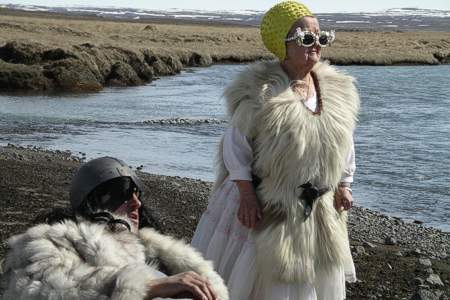 |
| Schlingensiefs Animatograph - Island Edition, Reykjavik, 2005 |
At first The Animatograph is to be set up for weekly periods in various places all over the earth, in Iceland, Germany, Central Europe, Africa and Central Asia as well as North and South America, and made available for "for use", e.g. in a Nepalese marketplace, in a Namibian slum, a "liberated zone" in East Germany, a Brazilian favela and an amusement park in the USA. Following this, the intention is to hold "happening weeks" at central locations in Berlin, Buenos Aires, New York, Reykjavik, Windhoek and Tokyo. Each station will create its own energy field, which will gradually become charged by its users, through everyday actions as well as through religious rites or artistic acts. In each place, the images, objects, sounds and music will be documented and, by means of projections and recordings, become part of the installation at the following stations. Thus, gradually, a hyperprojection will be created. The picture that is exposed will be that of a universal culture.
In a second phase, The Animatograph will be transported from the culturally dependent stage of everyday life back to the traditional artistic sphere and will be given presentations and performances at selected theaters (e.g. the Nationaltheater Reykjavik), opera houses (e.g. the Staatsoper Unter den Linden in Berlin), museums (e.g. the Kunsthalle Wien in Vienna, Museum of Modern Art New York) and festivals, where it will also be made available to its visitors for use.
"Even at the time when I was the assistant of experimental filmmaker Werner Nekes, I already had the dream of uniting all the media in which I had worked up to that time with the viewer to create a Gesamtorganismus, a synthesis of art and life in which the viewer no longer merely views, but steps out of his world into the vision-and-shadow world of the Animatograph, which he exposes like a photographic plate with his experiences and energy charges."
Christoph Schlingensief, 2005
 |
| Schlingensiefs Animatograph - Island Edition, Reykjavik, 2005 |
The project picks up efforts of first English film producer Robert William Paul (1869-1943), to follow "the trace of events" with a new camera eye and to take part in a "modern model of cultural information", which was created by development of photography, stage technology, illustrated press an early film.
"The possibilities of moved photographs are not in the least used so far."
Robert W. Paul, 1896
On March 25th, 1896 Paul presented his Animatograph in the London Alhambra Theatre, a projector, which he had first announced as Theatrograph, according to his own theatre experiences. 1891 Paul had opened a factory for electrical instruments.
In 1894 he began to copy the Edison Kinetoskop, together with photographer Birt Acres. First film tests they showed at the beginning of 1895. One year later Paul passed over to projection procedure and presented his Theatrograph on February 20th, 1896. A public demonstration followed on March 19th at the Egyptian Hall in Picadilly Circus. Artist David Devant projected all overlaying mobile photographs on stage of the theatre. Shortly after Paul briefly renamed the equipment Animatograph, because the theatre notation did not appear to him trend-setting enough. He set great store by the versatile usability of the Animatograph. It wasn´t his goal to reform the old medium (theatre) by new film; his goal was a medium-spreading culture apparatus, which projected not only on static stage, but even out of the illusory worlds on the real world stage.
"The Animatograph is not an artificial eye, not a camera, but a human visual organ. It is the viewer seeing himself and, in doing so, leaving traces, the way images leave traces on the retina."
Christoph Schlingensief, 2005
 |
| Schlingensiefs Animatograph - Island Edition, Reykjavik, 2005 |
The Animatograph unites different elements of visual and performing arts into a new format. Following avant-garde film and theatre and their respective aesthetic paradigms, the Animatograph formulates a breaking up of the projection field into projections that are of different size and scale, multiple, and that take in the whole space simultaneously. The necessity of going beyond the scope of the framed projection screen (or of the framed box of the theatre stage, for that matter) goes hand in hand with an architectural understanding of film space.
"Like a life-sized photographic plate, the Animatograph captures not only the materials of the respective location, but also its light exposure, the acoustic and energetic charge it receives through the people of that location."
Christoph Schlingensief, 2005
The Animatograph consists of various parts. On its base, it is a giant revolving stage, divided into numerous spatial segments to be used as projection surface to essential films by Christoph Schlingensief, Each segment will feature four to six newly edited looped film sequences and will function like an independent cell, producing and building its own dynamics of an idiosyncratic installation. Like an animate compound, the full beauty and power is revealed in the combination of the different cells. The growth of each cell will happen live in front of the spectator’s eye. At the same time, the spatial layering of the work psychically takes in the viewer, who is in the centre of action. The Animatograph not only offers insight into a moving and cross-fading – i.e. living – installation; it lets the viewer actually enter into and act upon the installation, which is thereby brought to life.
The human being is the organ that activates the spatial body, the "Life Machine". The human being’s eye is the camera that photographs the world. The Animatograph not only becomes visible, it becomes perceivable. It is necessary to animate it and explore it, to perceive it as an open stage, as a – to paraphrase Shakespeare – "stage of life".
 |
| Schlingensiefs Animatograph - Island Edition, Reykjavik, 2005 |
Schlingensief’s spatial concept radically calls into question the principles of the ubiquitous White Cube and Black Box of contemporary art presentation. "In recent times, scarcely a single museum or exhibition of contemporary art has not made use of one or more darkened rooms", notes Chris Dercon. "Don't they look like modernistic Greenbergian, formalistic white cubes? […] The only difference is that now the white cube has been painted black." No less artificial than the museum’s White Cube is the cinema’s Black Box. Its most distinctive feature, just as in the "evenly lit space" of the White Cube, is isolation. The Animatograph, Christoph Schlingensief’s "Life Machine", is an attempt to open up this sealed construction.
The Animatograph, the revolving space, increases its internal diversity and flexibility exponentially by means of its external mobility. Accordingly, Christoph Schlingensief has already held preliminary negotiations for taking the project to locations such as Iceland, Namibia, the USA and central Asia for filming. There are also plans to present and further develop the The Animatograph at the Burgtheater in Vienna, the Nationaltheater Reykjavik in Iceland, the Volksbühne in Berlin etc. In addition, other institutions have expressed interest in holding appropriate exhibitions of the The Animatograph.
On the revolving stage, a constantly fluctuating space-and-life world is installed, which, through new constructions, projections and, especially, its accessibility for visitors, continually changes and develops, without aiming for any particular final objective. Instead, the focus is on in-between times, our in-between time, the moment – one’s own little experience in the great and endless cosmos of the whole.
 |
| Schlingensiefs Animatograph - Island Edition, Reykjavik, 2005 |
Here (in the modern myth) as there (classical myths), the focus is on the human being and the human being’s relationship with nature and with beings such as gods or cultural heirs (heroes). The object is to discover and project the beliefs and stores of knowledge of a community as well as the things that keep the individual anchored in the world. In the search for the modern myth, the basic equipment includes specific fragments from Nordic, or to be more precise, old Icelandic lore (the "Edda"), Germanic mythology and African (nature) religions. The "Edda" contains visions ("Prophecy of the Vala") in which human beings are confronted with higher powers, gods and heroes, visions that are to be put on film for The Animatograph.An explicit theme of Germanic mythology is the search for worldly and divine bliss, as expressed, for example, in the Nibelungenlied and the legend of the Grail, a search which Schlingensief has already begun in his work with Wagnerian subject matter and which he intends to intensify in The Animatograph.
In African and also in Central Asian shamanism, the belief in gods and the experience of the inner self play an important role as a social regulation mechanism for the community. By means of the ritual integration of historic events through their symbolic reinterpretation, these cultures hope to gain insight and strength for their present survival and for the safeguarding of their common future. Through ancient European cultural evidence, The Animatograph creates a bridge to the world of African shamans and to the living tradition of Asian religious rituals, transforming them through the instruments of art (and through art itself) into the here and now. Ancient archetypes, which The Animatograph projects onto our era.
The realization of the The Animatograph is based on 3 cornerstones: Presentation (Cornerstone 1), Performance (Cornerstone 2) and Integration (Cornerstone 3). The 1st cornerstone involves the planning, construction and introduction of the animatographic prototype. It is being planned in Berlin, and will be built at "Klink & Bank" in Reykjavik, which can be used as a workshop, and introduced to the public for the first time there. The prototype will then serve as the actual stage installation for presentation (Great Animatograph).
The next goal is to produce a mobile animatographic "framework structure" for use in theaters and museums.
 |
| Schlingensiefs Animatograph - Island Edition, Reykjavik, 2005 |
The 2nd, performative cornerstone is the "model" of the prototype (Small Animatograph). It will be in continual use at the locations of the actionistic performances, each of which is to last a week (7 days). The performative character will not, basically, involve Christoph Schlingensief’s assuming a moderating function, as was the case, for example, in his "Bahnhofsmission" in Hamburg (1997) and his container happening "Bitte liebt Österreich" during the Vienna Festival 2000. Instead, the installation is to be set up at all different kinds of public locations for the use of everyone present.
The short-term goal of each performative happening is to achieve as much actionism as possible, without instructions and without any kind of stage direction. The actionistic potential will range from simple words or music through artistic adornment and configuration of the installation to cultural or religious rituals. The performative happenings will be documented on film, acoustically and in photographs.
 |
| Schlingensiefs Animatograph - Island Edition, Reykjavik, 2005 |
The 3rd cornerstone is the plan to integrate the local "models" of the The Animatograph set up in locations throughout the world into the prototype by means of collected physical and documentary fragments. The Small Animatographs, which will differ from one another according to the culture and conditions of the weekly locations, will be integrated chronologically into the large stage installation and in the course of the project should produce, literally, a cultural superstructure, a modern myth, a truly Great Animatograph.
In contrast to its mythological models, The Animatograph gives its viewers and occupants no guidelines for learning lessons for their own personal use. The Animatograph reflects and projects; in the end, it lives in the attitudes, hopes and fears of its "human organs". In this way it signifies for each individual (and for each individual differently) the confrontation of the genuine Self with the aesthetic sphere, in which authenticity (= Nature), achievement (= Culture) and belief (= Transcendence) merge with one another, dissolving the boundaries between realities and arts to create an animated reality, a living art – an animatography.
Additional information on Schlingensiefs Animatograph
|
|
|
|
|
The Animatograph
- 1. Overview (GERMAN)
- 2. Introduction (GER)
- 3. Theory (GER)
- ANIMATOGRAPH IV
(German only)
- ANIMATOGRAPH III
(German only)
- ANIMATOGRAPH II
(German only)
- ANIMATOGRAPH I
(German only)
Picture galleries
- Final Animatograph
- Island Shooting II
- Island Shooting I
Broadsheets
- Obsession
- Icelandic Party
- Icelandic Army
- Gene Database
External Links
- T-B A21
- Hauser & Wirth
- Isländisches
Nationaltheater
Reykjavik

ANIMATOGRAPH ICELAND EDITION
"House of Obsession"
by Christoph Schlingensief
Klink & Bank, Reykjavik
13.-15.5.2005
Im Auftrag von Thyssen-Bornemisza Art Contemporary
Idee / Regie:
Christoph Schlingensief
Darsteller: Karin Witt, Klaus Beyer, Christoph Schlingensief, Jörg van der Horst, Arnar Jonsson, Björn Thors, Eigill Heidar, Anton Palsson, Gudrun Gisladottir, Lilja Gudrun Porvaldsdottir, Nina Dögg Filipusdottir, Olafur Eigilsson, Solveig Arnarsdottir, Unnur Stefansdottir
Extra-Darsteller "Preisverleihung in Pingvellir": Gudmundur Oddur Magnusson, Daniel Björnsson, Snorri Asmundsson, Sirra Sigurdardottir, Erling Klingenberg, Sigridur Björg Sigurdardottir, Omar Stefansson, Nina Magnusdottir, Unnar Audarson
Bühnenkonstruktion: Thekla von Mülheim, Tobias Buser
Bühnenaufbau:
Tobias Buser, Daniel Björsson, Pall Banine, Pall Einarsson
Ausstattung:
Harry Johansson
Sound: David Por Jonsson, Helgi Svavar Helgason
Einrichtungsassistenz: Lars Skjalbriea, Finnur Ragnarsson, Petur Hauksson, Gudmundur Hauksson
Licht:
Björn Gudmundsson
Kostüm: Aino Laberenz
Kamera u. Schnitt: Kathrin Krottenthaler
Schnittassistenz: Kristian Zalinsky
Dramaturgie u. Internetredaktion: Jörg van der Horst
Beratung vor Ort: Henning Naß
Webdesign: Patrick Hilss
Produktionsleitung Deutschland: Anna Schulz, Holger Schulz
Produktionsleitg. Island: Nina Magnusdottir
Fotos: Aino Laberenz, Christoph Schlingensief, Jörg van der Horst
Besonderer Dank an: Tinna Gunnlaugsson, Lydur Sigurdsson, Margret Sigurdardottir, Askell Gunnlaugsson, Bjarni Ingolfsson, Asgeir Fridgeirsson, Claudia Kaloff, Hedi Pottag, Nathalia Stachon, Arno Waschk und Phillip Kummel
Mit freundlicher Unterstützung durch:
Galerie Hauser & Wirth, Zürich, Isländisches Nationaltheater, Reykjavik, Isländische Landesbank.
|
|
|
|
|
|